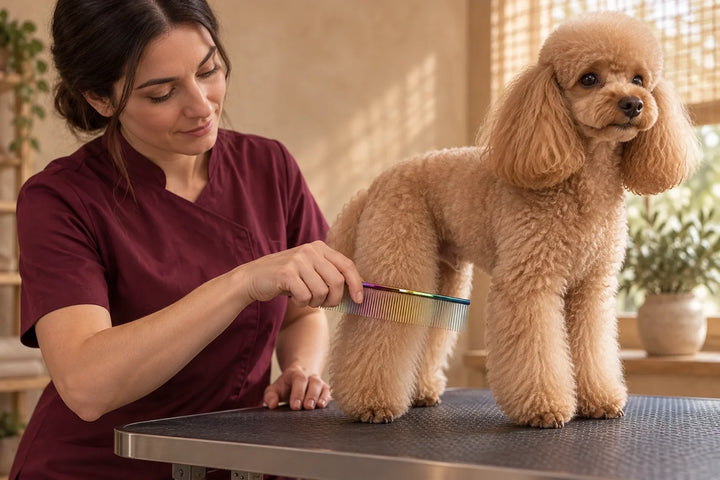
Map the Coat Lay Before You Set the Outline

A shoulder can look bulky because it carries too much coat. It can also look bulky because the coat has been lifted against its natural direction. Those are different problems, and only one is solved by removing more hair.
Before committing to an outline, make a quick map of how the coat settles. For a junior groomer, this is a useful way to turn a supervisor's instruction to “read the coat” into something you can actually practise.
Look once before you change anything
Observe the dry, untangled coat with the dog comfortably supported in its normal position. Identify the broad direction through the shoulder, ribs and hip, then look for places where that direction changes. Use the dog's own left and right when recording a feature.
Do not assume that the same region on the opposite side behaves identically. A small swirl or a change in density can make a symmetrical cutting plan produce an uneven-looking result.
The AKC's professional grooming standards ask groomers to consider coat characteristics and choose tools for the intended task. A simple direction map is one practical way to make that assessment useful at the table; it is not a separate qualification or a validated scoring system. Read the professional standards.
Use a section you can put back
On a suitable, fully prepared section, lift a small amount of hair with the comb, release it and watch where it falls. Compare that settled position with the shape you saw while the hair was lifted. You are looking for a repeatable change, not trying to force every strand into one direction.
The VUNRO 7-inch Lux Pintail Comb gives you a narrow sectioning end and a compact pin section. Use the tail to organise accessible hair with the point visible and clear of skin. Do not slide it blindly into a tangle, under an ear fold or towards the eye. Its precision comes from controlled access, not pressure.
Use a coarse/fine checking comb for an appropriate broader section. If you need force to establish the parting, stop and reassess the preparation or grooming plan.
Make a three-part note
| What to record | Useful example |
|---|---|
| Location | Right shoulder, just behind the neck transition |
| What happens after release | Hair settles forward into a small ridge |
| Finishing decision | Check the settled outline from the front before removing bulk |
This is more actionable than writing “difficult coat”. At the next visit, you can check whether the same feature is present before repeating the same correction.
Keep coat direction separate from the cutting direction
Your map describes the hair. It does not automatically tell you to clip against it. Changing the direction of a cutting pass can change the result, so the choice belongs in the agreed style and length plan.
Where clipping is appropriate, confirm the complete blade or guard system with your supervisor. Do not use a shorter attachment simply because a lifted patch appears higher than its surroundings. Restore the coat to the intended assessment position first.
For scissor finishing, decide whether you need a straight local line or a curved contour. Our 7.5-inch Precision Straight Scissors suit a planned straight cutting plane; the curved version offers another approach to a suitable rounded contour. Neither compensates for an outline assessed in the wrong position.
Check the decision from another view
After a conservative correction, release the coat and move yourself to a second viewing angle. Let the dog change position comfortably before checking again. Avoid holding the head or limb in an exaggerated pose to make the outline appear correct.
A useful training question is: “Did I remove an actual excess, or did I cut away hair that was temporarily standing up?” Discuss that question over a small, suitable finishing area with an experienced groomer. It develops judgement more effectively than repeatedly trimming until the coat looks flat from one viewpoint.
For the next step, read Straight or Curved Scissors: Choose the Cutting Plane First.
Sources and scope
AKC National Core Professional Dog Grooming Educational Standards, particularly coat assessment and tool selection. The mapping exercise is a practical training method. Product details come from the linked VUNRO specifications.
Keep learning
More from the Blade Blog

Separate a Dry Surface from a Dry Coat
Read the guide →
Check the Outline in Motion Before Making Another Cut
Read the guide →